Blog
What is prompt engineering? A plain-English guide for beginners
Short answer: Prompt engineering is the skill of writing instructions an AI can follow well: being specific, giving context and examples, asking for a format, and improving the prompt step by step based on what comes back.
Published
"Prompt engineering" sounds technical, but the idea is simple. A prompt is what you type to an AI tool. Prompt engineering is getting good at writing prompts, so the AI's answer is closer to what you wanted the first time.
You don't need to code, and you don't need special words. You need clear instructions and a habit of improving them.
Why the same AI gives different answers
An AI model doesn't read your mind. It reads your words and predicts a useful reply. If your words are vague, it has to guess what you meant, and guesses are often generic.
Compare two prompts:
Write about exercise.
Write a 150-word beginner's guide to starting a walking routine, for a 45-year-old who sits at a desk all day. Friendly tone, 3 short tips, no medical claims.
The second prompt tells the AI the length, the topic, the audience, the tone, the format and a limit. Nothing about it is clever. It is just specific.
The core techniques
Most of prompt engineering comes down to a few habits.
1. Be specific about the task
Say exactly what you want done, in one clear sentence. "Summarise this article in 3 bullets" beats "help me with this article".
2. Give context
Include the facts the AI needs: who the reader is, what the goal is, and the material itself. Paste the text or the job description. Don't describe it from memory.
3. Set a role
"Act as a senior recruiter" or "Act as a patient maths teacher" sets a point of view and a level of detail. It helps most for advice and writing tasks. It isn't magic, and it works best together with the task and the context.
4. Say what format you want
Ask for the shape of the answer: a table, five bullets, a 120-word email, plain paragraphs. Without a format, the AI picks one for you.
5. Show an example
If you want a specific style, show one. This is often called giving examples (or "few-shot" prompting). For instance:
Write product taglines in this style:
Example 1: "Fresh coffee. Zero fuss."
Example 2: "Clean floors. Free evenings."

Now write 3 taglines for a reusable water bottle.
The AI copies the pattern: short, two parts, a full stop between them. An example often communicates a style better than a paragraph of description.
6. Add limits
Limits keep the answer on track: a word count, a tone, words to avoid, things not to invent. "Do not make up any statistics" is a useful limit for any factual task.
7. Ask it to ask you
When you aren't sure what details to give, let the AI find out. The resume bullets prompt does this: if a bullet has no number, the AI asks you a question that helps you find one, instead of inventing a figure. The quiz prompt works the same way for learning: it asks you one question at a time.
8. Break big jobs into steps
A big task in one prompt can go wrong in several places at once. Split it: first ask for an outline, then approve it, then ask for the full draft. Each step is easier to check and fix.
9. Iterate
Your first prompt is a draft. Look at the result, decide what's wrong, change one thing, and run it again. Our guide to editing an AI prompt explains the routine.
A simple formula to remember
Most good prompts have some mix of role, task, context, format and constraints. Only the task is essential. The full guide to the formula has before-and-after examples.
Does it work the same in every tool?
For text tasks, mostly yes. Chat tools such as ChatGPT, Claude and Gemini respond well to the same habits. Image and video tools have their own settings and vocabulary. See ChatGPT vs Claude vs Gemini and why a Midjourney prompt isn't working.
Do you need to learn this?
You can use AI without learning any of this, and templates are a good way to start. If you use AI often, a little practice pays off quickly: fewer retries, better first drafts, and less time fixing generic output. Some people do work as "prompt engineers", but for most of us it is just a useful skill, like searching the web well.
Two limits are worth remembering:
- A good prompt doesn't make the answer true. AI can state wrong things confidently. Check facts and numbers that matter.
- There's no perfect prompt. Different tasks and tools need different details, so treat prompts as drafts.
Where to start
- Pick a task you do often, such as an email, a summary or a study plan.
- Copy a ready-made prompt from the prompt library and fill in the [BRACKETED] fields.
- Read the result, change one detail, and run it again.
- Save the version that works.
If you'd rather answer a few questions and have the prompt written for you, try the prompt builder. To learn how templates work, read how to use an AI prompt template.
Prompts to try
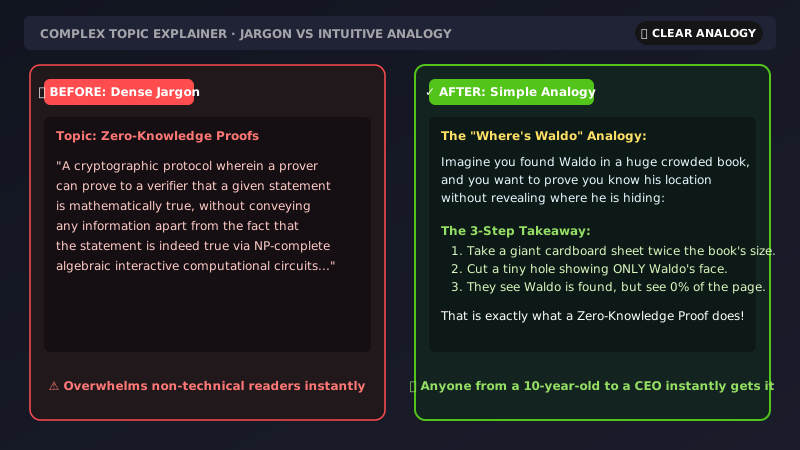 Text & chatExplain any complex topic simplyChatGPT · Gemini · Claude
Text & chatSummarise anything in 3 bulletsChatGPT · Gemini · Claude
Text & chatLearn any topic through quiz questionsChatGPT · Gemini · Claude
Text & chatRewrite resume bullets with real impactChatGPT · Gemini · Claude
Text & chat · TrendingMock interview practice (one question at a time)ChatGPT · Gemini · Claude
Text & chatExplain any complex topic simplyChatGPT · Gemini · Claude
Text & chatSummarise anything in 3 bulletsChatGPT · Gemini · Claude
Text & chatLearn any topic through quiz questionsChatGPT · Gemini · Claude
Text & chatRewrite resume bullets with real impactChatGPT · Gemini · Claude
Text & chat · TrendingMock interview practice (one question at a time)ChatGPT · Gemini · Claude