How to use Claude Sonnet 5.5: where to find it, what to set and 6 prompts to try
Published

Short answerClaude Sonnet 5.5 is Anthropic's fast, low-cost everyday model, released on 28 September 2026. Pick it from the model menu in Claude, give it the whole task and a clear finish line, tell it when to stop and ask for checks, and move up to Opus only if the work is long or hard.
Anthropic released Claude Sonnet 5.5 on 28 September 2026. It's the model most people should start with: quick, cheaper than Opus, and good enough for writing, studying, analysis and everyday coding. This guide shows you where to find it, what settings matter, and six prompts that suit the way it works.
What's new in Sonnet 5.5
These figures come from Anthropic's announcement:
| What | Sonnet 5.5 |
|---|---|
| Speed | More than 30% faster output than Sonnet 5 |
| Cost | Up to 30% less for most work, because it uses fewer tokens per task |
| API price | $2 per million input tokens, $10 per million output tokens (the same price as Sonnet 5) |
| Context window | 1 million tokens, with replies up to 128,000 tokens |
| Knowledge cutoff | June 2026 |
| API name | claude-sonnet-5-5 |
Anthropic reports big gains in coding. On Terminal-Bench 4.0, a test of agentic coding, it scores 70.6% against 10.3% for Sonnet 5. It also says Sonnet 5.5 is the first Sonnet model to beat Pokémon Red working only from screenshots, and that its writing is clearer and easier to work with. Benchmarks are a guide, not a promise, so judge it on your own tasks.
Anthropic is clear about the limit: for the hardest, longest tasks, an Opus model is still the better choice. See which Claude model to use.
Where to find it
- In the Claude app or website: open the model menu and choose Claude Sonnet 5.5. PCWorld reports it is the default model for free Claude users. Which models you see depends on your plan, so check your own menu.
- In Claude Code: choose it with the model command or setting.
- In the API: use the model name
claude-sonnet-5-5. It's also on Amazon Bedrock, Google Cloud and Microsoft Foundry.
The settings that matter
Effort
Effort controls how much Sonnet 5.5 thinks before it replies. More thinking usually gives a better answer but takes longer and uses more of your allowance or budget.
| Effort | Good for |
|---|---|
| Low | Quick questions and simple rewrites |
| Medium | Well-defined coding and everyday work |
| High (default in the API) | Harder problems, longer tasks |
| Xhigh and max | Only when you've tested and seen a real gain |
Anthropic's guide says the levels are recalibrated, so a setting that suited Sonnet 5 may behave differently. Two things to know:
- Telling it "think harder" or "think less" in the prompt doesn't reliably change how much it thinks. Change the effort setting instead.
- From medium upwards, it thinks briefly before almost every reply, even a greeting. For fast chat, use low.
Not every app shows an effort control. In the API and in tools such as Claude Code you can set it yourself, so check what yours offers.
Thinking
Sonnet 5.5 uses adaptive thinking by default, meaning it decides how much reasoning a task needs. Developers can switch off up-front thinking with a setting called between_tools. That is covered in our Sonnet 5.5 coding guide.
6 prompts that suit Sonnet 5.5
The first three are based on lines Anthropic suggests for its system prompts. You can paste them into a chat, or into Claude's custom instructions if you want them to apply every time.
1. Ask for ideas without it starting to build
Sonnet 5.5 can jump ahead on open-ended requests, building a document or a whole page when you only wanted options. That wastes your usage allowance. PCWorld's report on the launch highlights this line from Anthropic:
When I ask for ideas, options or a plan, give me that and stop. Don't start building or changing anything until I say to go ahead.
2. Make it finish the job
At lower effort, on long tasks, it may stop to check in more often than you'd like. Anthropic's fix, in our words:
Keep working until everything I asked for is done. Only stop to ask me if you can't go on without me, or before a risky step. When it's done and checked, stop and report. Don't add extra features, files or notes I didn't ask for. If you think one would help, mention it at the end.
3. Ask it to check things that may have changed
Sonnet 5.5 sometimes answers from what it already knows when a quick search would catch a change, such as a price, a rule or a deadline. Turn on search in Claude if your plan offers it, then add:
Search for the current answer before you reply. For anything that may have changed since your training, such as what is allowed, required or charged, check a current source even if you feel sure. Give me the link for each fact.
4. Analyse a long document without endless questions
Pasting a 100-page document with no guidance often makes it ask what you want. Say what you want up front:
Analyse the document below.
Focus on: [THE PART THAT MATTERS, e.g. the refund policy and the deadlines].
Ignore: [WHAT TO SKIP, e.g. the appendix].
Return: the main argument in 3 sentences, the 5 key findings, any gaps or assumptions, and what I should do next.
Use only the document. If something isn't stated, write "not stated".

<document>
[PASTE YOUR DOCUMENT HERE]
</document>
Our research paper summary prompt and executive summary prompt do this for you.
5. Edit without rewriting
Edit the text below for clarity and concision.
Audience: [WHO WILL READ IT].
Tone: [E.G. friendly and direct].
Length: [TARGET WORD COUNT].
Keep the meaning and my voice. Don't add new information. Show what you changed as a short list at the end.

[PASTE YOUR TEXT HERE]
For a version that protects your style, try the proofread and keep my voice prompt.
6. Get data back in a fixed format
Sonnet 5.5 sometimes skips thinking on tasks that need a few steps of working out when you ask for JSON. Anthropic suggests adding one line to the end of the instructions:
Extract the information below and return valid JSON with these fields: [YOUR FIELDS].
Use only stated data. Leave out any field that isn't in the text. Return only the JSON.
Think the problem through before you answer.

[PASTE THE TEXT HERE]
Anthropic says that line brings accuracy close to what you get at a higher effort setting.
The 6-part prompt to remember
Whatever the task, this structure works well:
- Task: what you want done.
- Context: who it's for and why.
- Constraints: what must not change.
- Output: the shape and length of the answer.
- Scope and stop: when to finish, and what not to add.
- Check: how it should verify its work (run the tests, cite the source, compare to the table).
Our prompt builder fills in a version of this for you.
Mistakes to avoid
- Assuming max effort is always better. Longer thinking isn't always better thinking, and it costs more.
- Copying old Sonnet 5 settings. Effort levels changed, so test again.
- Accepting "done" without proof. For code, ask it to run the tests. For research, ask for links.
- Trusting it with current facts and no search. Its knowledge stops at June 2026.
- Pasting a huge document with no question. Say what you want from it.
Where to go from here
Developers should read our guide to Sonnet 5.5 for coding. If you want to compare it with the bigger models, see Opus 5.5 and Fable 5.1. The Claude prompts page has hundreds of free prompts that work on it.
Quick checklist
- Choose Sonnet 5.5 for everyday work; move to Opus for long, hard tasks.
- Give the whole task and a clear finish line at the start.
- Use effort, not "think harder", to control thinking.
- Say "ideas first, don't build yet" when you want options.
- Ask for links when facts may have changed.
- Ask it to check its work before it says it's done.
Sonnet 5.5 is fast and capable, but it can still be wrong. Check the names, numbers and dates you plan to use.
Prompts to try
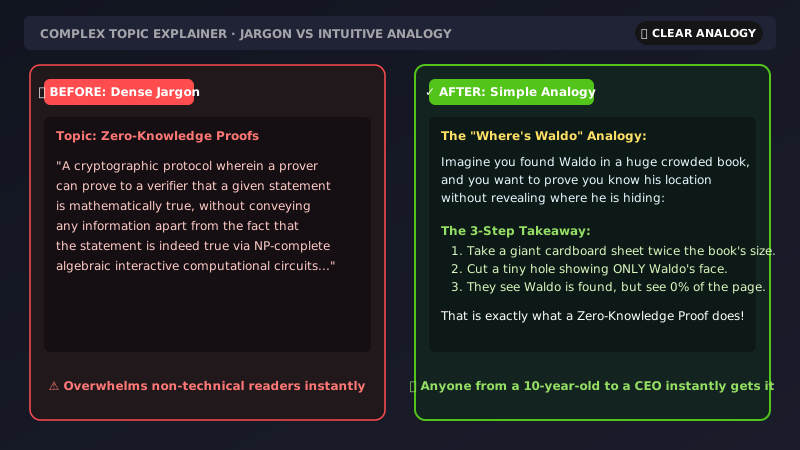 Explain any complex topic simplyChatGPT · Gemini · Claude
Write an executive summary of a long documentChatGPT · Gemini · Claude
Summarise a research paperChatGPT · Gemini · Claude
Proofread without changing your voiceChatGPT · Gemini · Claude
Plan my day and prioritise tasksChatGPT · Gemini · Claude
Explain any complex topic simplyChatGPT · Gemini · Claude
Write an executive summary of a long documentChatGPT · Gemini · Claude
Summarise a research paperChatGPT · Gemini · Claude
Proofread without changing your voiceChatGPT · Gemini · Claude
Plan my day and prioritise tasksChatGPT · Gemini · Claude



Comments
No comments yet. Be the first to share what worked for you.