Blog
AI prompts for your job search: resume, cover letter, interview and offer
Short answer: Use AI to draft and practise, not to make things up. Give it your real achievements and the real job description, ask it to flag what it doesn't know, and check every number before it goes into an application.
Published

AI can save a lot of time in a job search, and it can also cause harm if you let it invent things. Recruiters and hiring managers notice generic, inflated writing, and a made-up achievement can end an interview in one question.
This guide walks through a job search in order, and shows where a prompt helps at each step. All the prompts named here are free to copy from the job search prompts page.
The ground rules
These four rules apply at every step:
- Give it real material. Paste your actual bullets, the actual job description and your real achievements.
- Never let it invent numbers. If you don't have a figure, ask the AI to ask you questions instead.
- Ask it to say when it is unsure. "If you are unsure about a fact, say so instead of guessing."
- Read everything before you send it. The final version has to be true and sound like you.
Step 1: Fix your resume bullets
Weak bullets describe duties. Strong bullets show results. The resume bullets prompt rewrites your bullets in the format action verb + what you did + result. It also does something important:
If I gave no number, ask me a question for each bullet that would help me find one (time saved, money, volume, percentage). Do not invent figures.
Answer its questions honestly, then ask for a rewrite with the real numbers. If you have no number for a bullet, a clear, specific description is better than a made-up percentage.
If you are applying to companies that use applicant tracking systems, the ATS-friendly resume prompt also works the keywords from the job description into your bullets. Only keep keywords that describe things you have really done.
Step 2: Write a summary and a LinkedIn profile
Once your bullets are strong, the summary at the top of your resume is easier to write. Use the resume summary prompt to get three options, then pick one and edit it into your own words.
For LinkedIn, the headline prompt gives you 10 options, and the About section prompt helps with the longer text. Recruiters search by job title and skills, so keep the exact title you want near the start of the headline.
Step 3: Tailor a cover letter
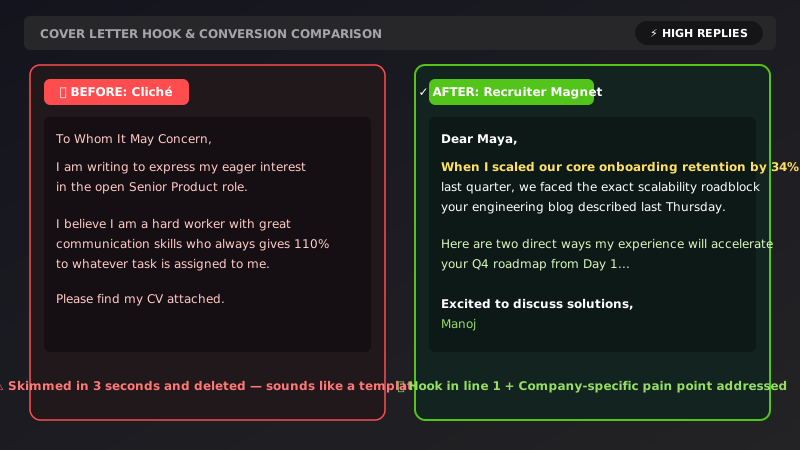
A cover letter is worth writing when the job description asks for one, or when you can connect your work to the company's needs. The tailored cover letter prompt needs three real inputs: the top requirements from the job post, two of your achievements, and why you want this company.
The prompt tells the AI to avoid the opening "I am writing to apply…" and to stay under 250 words. After the first draft:
- Replace any general claims with a specific example.
- Cut anything you couldn't say out loud in an interview.
- Ask for a version that "sounds more like me", and paste a paragraph you wrote yourself.
Step 4: Research the company
Before an interview, use the company research prompt to get a briefing: what the company does, recent news, what people in the role struggle with, and five questions to ask. Turn on web search in your chatbot so the news is current, and check any important fact on the company's own website.
Step 5: Practise the interview
The mock interview prompt asks one question at a time, waits for your answer, then scores it and shows a stronger version. It works best when you:
- Answer as you would in the real interview, out loud if your tool has voice mode.
- Use real examples from your own work, not the sample answers it gives.
- Ask it to focus on the kind of question you find hardest, such as behavioural questions.
Sample answers from an AI are a guide to structure. Don't memorise them or copy them into your own story.
Step 6: Follow up
After the interview, send a short thank-you within a day. The thank-you email prompt produces a short, warm email that mentions one specific thing you discussed. If you don't hear back, the follow-up prompt helps you write a polite nudge.
Step 7: Negotiate the offer
When an offer arrives, the salary negotiation prompt helps you check whether your target is reasonable, draft an email, and prepare for phone replies. Use it with real numbers and real leverage only. It is not a good idea to claim another offer you don't have.
What AI cannot do for you
- It can't know your real achievements. Only you can supply them.
- It can't guarantee an interview. A strong, honest application still depends on the fit.
- It can be wrong about a company or a role. Check the facts.
Prompts to try
 Text & chatTailored cover letter that gets interviewsChatGPT · Gemini · Claude
Text & chat · TrendingResearch a company before your interviewChatGPT · Gemini · Claude
Text & chat · TrendingMock interview practice (one question at a time)ChatGPT · Gemini · Claude
Text & chatNegotiate a better salary offerChatGPT · Gemini · Claude
Text & chatTailored cover letter that gets interviewsChatGPT · Gemini · Claude
Text & chat · TrendingResearch a company before your interviewChatGPT · Gemini · Claude
Text & chat · TrendingMock interview practice (one question at a time)ChatGPT · Gemini · Claude
Text & chatNegotiate a better salary offerChatGPT · Gemini · Claude