AI prompts for writing better professional emails
Published

Short answerGive the AI the situation, the relationship with the reader, and what you want to happen next, not just the topic. State the tone you want and the length, and ask for one draft plus one shorter alternative.
Most people's problem with email isn't knowing what to say, it's knowing how to say it without sounding too stiff, too blunt, or too long. An AI chatbot is good at this if you give it the actual situation instead of a vague request like "write me an email about X".
The difference a good prompt makes
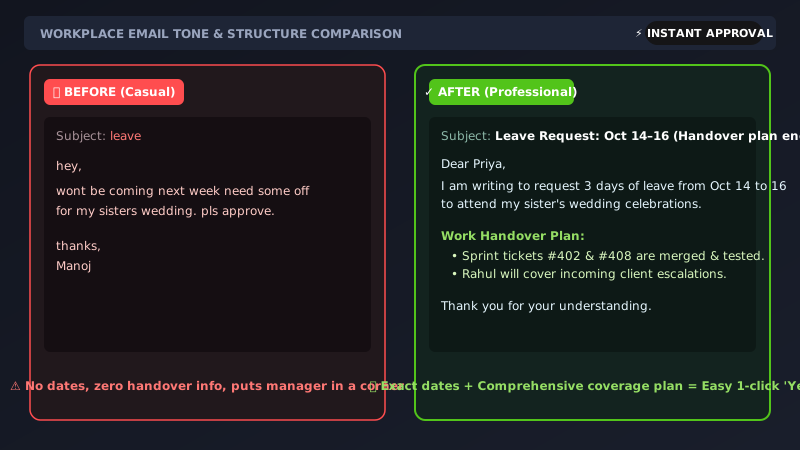
A weak prompt:
Write an email asking for leave.
A strong prompt:
Write a short email to my manager asking for 3 days of leave from [DATES], for [REASON, e.g. a family event]. Tone: polite and direct, not overly apologetic. Mention I'll hand over my current tasks to [COLLEAGUE] before I go. Keep it under 100 words.
The second version gives the dates, the reason, what happens to the work while you're away, and the tone, so the first draft is usually close to ready to send. The leave request email prompt follows this structure.
Cooling down an email before you send it
The situation: you've written a reply to something that annoyed you, and you know it's too sharp to send as-is.
The fix: don't ask the AI to write a new email from scratch. Paste your draft and ask for a calmer version that keeps your point:
Rewrite this email to be firm and clear, but not angry or sarcastic. Keep every point I'm making, just remove the emotional language.

[PASTE YOUR DRAFT]
The calm angry email prompt is built for exactly this, and it's worth using even on emails you're fairly sure about, since it's easy to misjudge your own tone when you're frustrated.
Cold outreach that doesn't read like a template
Cold emails get ignored when they're obviously generic. Give the AI something specific about the person or company you're writing to, not just your own pitch:
Write a short cold email to [NAME/ROLE] at [COMPANY], introducing [YOUR PRODUCT/SERVICE]. Reference that they [SPECIFIC DETAIL, e.g. recently launched X, posted about Y]. One clear ask at the end: [WHAT YOU WANT, e.g. a 15-minute call]. Under 120 words. No generic opening like "I hope this finds you well".
The B2B cold email prompt uses this shape, and naming something you don't want ("no generic opening") is often more useful than listing what you do want, since AI models default to a few very common openers unless told otherwise.
Getting your email opened in the first place
A well-written email with a weak subject line doesn't get read. Ask for options rather than one line, and compare:
Give me 8 subject line options for an email about [TOPIC]. Mix short, curiosity-based and direct ones. Under 60 characters each.
The email subject lines prompt generates a spread like this, and picking from several options is almost always better than accepting the first one you're given.
Getting paid without sounding aggressive
Payment reminders are one of the hardest tones to get right: firm enough to work, polite enough to keep the relationship. Be specific about which reminder number this is, since a first nudge and a third follow-up should read differently:
Write a payment reminder email for an invoice that's [NUMBER] days overdue. This is my [FIRST/SECOND/THIRD] reminder. Tone: polite but clear, with the invoice number and amount restated. Include a direct next step if it's the final reminder.
The payment reminder prompt adjusts well for this, and telling it which reminder number you're on is the detail most people leave out, which is why a lot of AI-drafted reminders all sound the same regardless of how much patience has actually run out.
A few things that improve every email prompt
- Say who's reading it. A manager, a client and a stranger you're cold-emailing all need a different register, and the AI can't guess which one unless you say.
- Give a word or length limit. Without one, most AI chatbots default to longer than you need.
- Ask for one alternative. "Give me this, then a shorter, more casual version" costs nothing extra and often the second one is the better fit.
- Proofread the specifics yourself. Names, dates, amounts and invoice numbers should always be checked, since the AI will confidently fill in a placeholder if you forget to replace one.
Where to go from here
For writing in a specific voice or tone more generally, see prompts for small businesses. Browse more ready-made options in the chat and writing prompts collection, or build your own with the prompt builder.
Quick checklist
- State who's reading the email and your relationship to them.
- Give the actual situation: dates, numbers, names, not just the topic.
- Set a tone and a word limit.
- Ask for a second, shorter or more casual version to compare.
- Check every specific detail before you send.
Prompts to try
 Leave request email to your managerChatGPT · Gemini · Claude
 Rewrite an angry email (firm but calm)ChatGPT · Gemini · Claude
 Write a cold email that gets a reply (B2B)ChatGPT · Gemini · Claude
Generate email subject lines that get openedChatGPT · Gemini · Claude
Write a payment reminder that gets you paidChatGPT · Gemini · Claude
Write a cold email that gets a reply (B2B)ChatGPT · Gemini · Claude
Generate email subject lines that get openedChatGPT · Gemini · Claude
Write a payment reminder that gets you paidChatGPT · Gemini · Claude



Comments
No comments yet. Be the first to share what worked for you.