GPT-6 Sol and Luna: which one to pick and how to prompt them
Published

Short answerUse Sol for harder work, such as long reports, analysis and code, and Luna for quick, focused tasks. Prompt both the same way: say what "done" looks like, give the facts they need, keep instructions plain and free of contradictions, and raise the reasoning effort only when a task needs it.
OpenAI released GPT-6 Sol and GPT-6 Luna on 22 September 2026, a few weeks after the bigger GPT-6 Astra model. If you use ChatGPT, you'll probably see these names in the model picker. This guide explains what each one is for and how to write prompts that suit them.
Sol, Luna and Astra in plain words
OpenAI describes the two new models as bringing "frontier intelligence to everyday work" with different balances of capability and cost:
| Model | What OpenAI says it's for | Use it when |
|---|---|---|
| GPT-6 Sol | Difficult work tasks, with higher usage limits and lower cost | Reports, analysis, planning, writing that needs care, code |
| GPT-6 Luna | The most efficient model, for focused, high-volume tasks | Quick rewrites, summaries, emails, sorting and tagging |
| GPT-6 Astra | OpenAI's top GPT-6 model, launched earlier in September | The hardest problems, if your plan includes it |
According to OpenAI's developer announcement, Sol and Luna are available to Plus, Pro, Business, Enterprise and Edu users, and Free and Go users can use Luna in the ChatGPT desktop app. For developers, OpenAI says API prices for both are 50% lower than their GPT-5.6 promotional pricing.
A simple rule: start with Luna for anything you could explain in one sentence. Switch to Sol when the answer needs several steps, a lot of material, or careful judgement.
What's better, and why it changes your prompts
OpenAI says both models make fewer mistakes than the GPT-5.6 versions, especially when an answer depends on dates, numbers, sources, rules or assumptions, because they make better use of the sources they find.
That's useful, but only if your prompt gives them the right material. A model that sticks to sources is only as good as the sources you give it. So the biggest improvement you can make is to paste the facts in, rather than hoping it knows them.
5 habits that suit GPT-6 prompts
1. Say what "done" looks like
OpenAI's guidance for GPT-6 Astra says it helps to define completion before the model starts. The same works for Sol and Luna. Instead of "help me with my presentation", say what a finished result includes.
Weak:
Help me with my presentation about our new app.
Strong:
Goal: A 6-slide outline for a 10-minute talk about our new app to [AUDIENCE, e.g. local shop owners].
Done means: a title for each slide, 3 short bullets per slide, and one line of speaker notes.
Material: [PASTE YOUR NOTES OR FEATURE LIST]
Rules: Use only the features in my notes. If something is missing, list it as a question at the end.
2. Use plain words and direct instructions
OpenAI's prompt guidance recommends plain, simple language, concrete examples and precise verbs. "Shorten this to 80 words and keep the three prices" works better than "make it a bit tighter".
3. Remove conflicting instructions
OpenAI notes that GPT-6 Astra follows long instructions well but is more sensitive to what's in them, and unclear or conflicting guidance can make it stop early. Old prompts often say "be detailed" in one line and "keep it short" in another. Read your saved prompts once and delete anything that contradicts the rest.
4. Paste the facts it should use
Because these models are built to lean on sources, give them one. Paste the table, the email thread or the page you want it to work from, and add this line:
Use only the material below. For every number or date in your answer, say where it came from. If something isn't in the material, write "not stated" instead of guessing.

[PASTE YOUR MATERIAL HERE]
This makes the answer easy to check, which matters for anything you plan to send or act on.
5. Match the effort to the task
OpenAI says you can raise the reasoning effort for harder tasks and lower it for simple follow-ups. If ChatGPT offers you a thinking option, use it for the hard tasks only. In the API, effort is a setting. Don't pay in waiting time for a task that doesn't need it. A thank-you note doesn't need deep thought. A budget plan might.
Ready-made prompts to try
You don't have to write every prompt from scratch. These PromptUp cards work well with both models:
- Long document to short brief: the executive summary prompt turns a report into a headline, key points and next steps. Sol handles long material better.
- Understand something new: the explain it simply prompt is a good fit for Luna. It's quick and focused.
- Plan a project: the one-page project plan prompt gives you goals, steps and owners on a single page.
- Make AI text sound like you: the humanise AI text prompt removes stiff phrases and filler words.
A copy-ready GPT-6 template
Fill in the brackets and paste it into ChatGPT. It works with Sol or Luna.
Role: You are [ROLE, e.g. a friendly, experienced small-business adviser].
Task: [WHAT YOU WANT, in one or two sentences].
Audience: [WHO WILL READ IT].
Done means: [WHAT A FINISHED RESULT INCLUDES].
Format: [LENGTH AND SHAPE, e.g. 5 bullets, each under 20 words].
Avoid: [THINGS YOU DON'T WANT, e.g. jargon, emojis, a summary at the end].
Facts: Use only the material below. Say "not stated" if something is missing.

[PASTE YOUR MATERIAL HERE]
If the first answer is close but not right, don't start again. Reply with one change at a time: "Same, but half as long" or "Same, but for a 12-year-old."
Where to go from here
If you use more than one assistant, our guide to ChatGPT vs Claude vs Gemini prompts shows how the same prompt behaves in each. You'll find hundreds of free, tested prompts in the PromptUp ChatGPT prompts collection, and the prompt builder can fill in the template above for you.
Quick checklist
- Luna for quick, focused tasks. Sol for harder, longer work.
- Say what "done" looks like before it starts.
- Use plain words and precise verbs.
- Delete instructions that contradict each other.
- Paste the facts, and ask for "not stated" instead of guesses.
- Raise the effort only when the task needs it.
GPT-6 makes fewer mistakes, but it still makes some. Check names, numbers and dates yourself before you rely on them.
Prompts to try
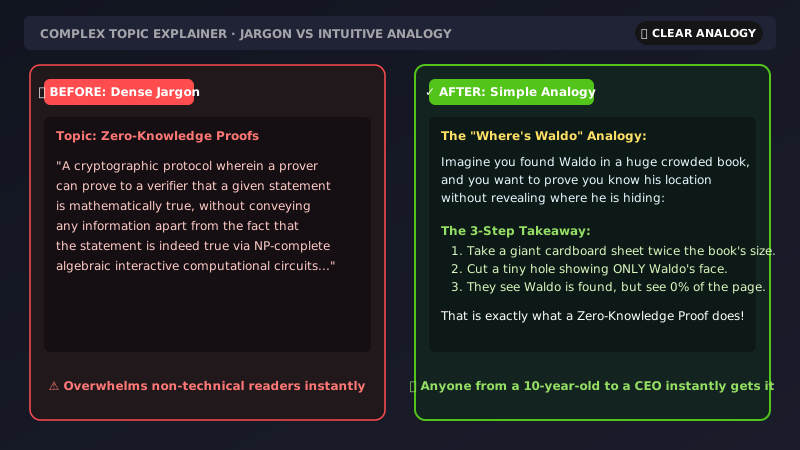 Explain any complex topic simplyChatGPT · Gemini · Claude
Create a one-page project planChatGPT · Gemini · Claude
Make AI-written text sound humanChatGPT · Gemini · Claude
Compare yourself with three competitorsChatGPT · Gemini · Claude
Explain any complex topic simplyChatGPT · Gemini · Claude
Create a one-page project planChatGPT · Gemini · Claude
Make AI-written text sound humanChatGPT · Gemini · Claude
Compare yourself with three competitorsChatGPT · Gemini · Claude



Comments
No comments yet. Be the first to share what worked for you.