GPS is free for everyone partly because of a plane that flew off course
Published · Facts checked against the sources at the end
 Watch the reel on YouTube (opens in a new tab)
The short versionIn 1983 a Korean airliner strayed into Soviet airspace and was shot down, killing all 269 people on board. Two weeks later the White House said civilian aircraft could use GPS once it was ready. Civilians got a deliberately blurred signal until 1 May 2000, when the blur was switched off and phone-level accuracy became possible.
- 269people killed on Flight 007
- 15 daysfrom the shootdown to the GPS statement
- 45 m to 6.3 merror at one US test station when the blur was switched off
- 4.9 mtypical phone accuracy under open sky today
What happened to Flight 007
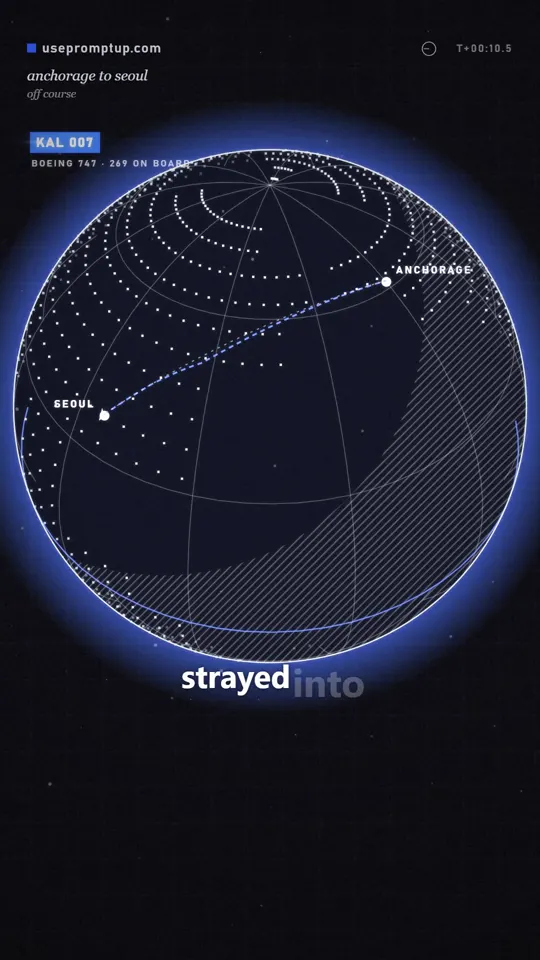
On 1 September 1983, Korean Air Lines Flight 007, a Boeing 747 flying from Anchorage to Seoul, drifted hundreds of kilometres off its planned route and into Soviet airspace. A Soviet fighter shot it down near Sakhalin Island. All 269 people on board were killed.
Why was it so far off course? The investigation by ICAO, the UN aviation body, concluded in 1993 that the autopilot was most likely left on a fixed compass heading instead of following the plane's navigation system, and the crew did not notice. The plane flew in a nearly straight line, slowly drifting away from its route for hours.
The promise that followed
Two weeks later, on 16 September 1983, White House deputy press secretary Larry Speakes read a statement saying that "the President has determined that the United States is prepared to make available to civilian aircraft the facilities of its Global Positioning System when it becomes operational in 1988."
GPS was a US military system that was still being built. A civilian signal was already part of its design, but the statement turned it into a public promise, made because of a disaster that better navigation might have prevented.
The 1983 statement did not actually use the word "free". The promise to provide the civilian signal free of direct user fees came in later US policy, written down in 1996 and still in place today.
The catch: a blurred signal
When GPS was ready, civilians could use it, but not at full quality. The military added a deliberate error to the civilian signal, called Selective Availability, so that an enemy could not use GPS as precisely as US forces.
The effect was large. At one US measuring station in Kentucky, 95% of position fixes fell within about 45 metres while the blur was on. That is fine for a ship at sea, but useless for telling which street you are on.
The night it was switched off
On 1 May 2000, President Bill Clinton announced that Selective Availability would be discontinued at midnight. The White House said civilian users would be about ten times more accurate. Selective Availability ended a few minutes after midnight Eastern time, on all satellites at once.
At that same Kentucky station, the error dropped from about 45 metres to about 6.3 metres overnight. In 2007 the US decided that the next generation of satellites, GPS III, would be built without the feature at all.
What the reel left out
- The reel says Reagan announced GPS would be "free". The statement was read by his press secretary on his behalf, and it promised access, not "free". The no-fee promise came later.
- GPS for civilians was already in the plans before 1983. Flight 007 made it a public commitment and is the reason the story is usually told this way.
- The year 2000 change made GPS about ten times more accurate. The exact numbers depend on where and how you measure.
Why this still matters
Every map app, ride-hailing app and delivery tracker depends on that free, unblurred signal. GPS.gov says a GPS-enabled phone is typically accurate to within about 4.9 metres under open sky, and worse near tall buildings, bridges and trees. Most phones today also use other countries' systems, such as Europe's Galileo, alongside GPS to get a faster and steadier fix.
Timeline
- 1 Sep 1983Korean Air Lines Flight 007, Anchorage to Seoul, strays into Soviet airspace and is shot down near Sakhalin. All 269 on board die.
- 16 Sep 1983The White House says GPS will be made available to civilian aircraft once it is operational.
- 1995GPS is declared fully operational. Civilians get a deliberately degraded signal (Selective Availability).
- 1996US policy promises the civilian signal free of direct user fees and plans to end Selective Availability.
- 1 May 2000President Clinton announces Selective Availability will stop at midnight. It ends a few minutes after midnight EDT.
- 2007The US decides the next generation of GPS satellites, GPS III, will not even have the feature.
Go further with AI
Paste one of these into ChatGPT, Gemini or Claude. Replace the [BRACKETED] parts first. AI chatbots can get dates and numbers wrong, so check anything important against the sources below.
Explain how my phone works out where I am using GPS satellites, in plain English and in 5 short steps. Assume I know nothing about physics, and tell me why it gets worse near tall buildings.
Make a short timeline from Korean Air Lines Flight 007 (1983) to Selective Availability being switched off (2000). One line per event. Mark any fact you are not sure of so I can check it.
Turn this story into a 60-second talk for a [school class / team meeting]. Start with a hook question, keep the sentences short, and end with one thing the audience can check on their own phone: [PASTE THE STORY]
Frequently asked questions
Is GPS really free to use?
Yes. US policy since 1996 is to provide the civilian GPS signal worldwide, free of direct user fees. You pay for the device and any app or data plan, not for the signal itself.
What was Selective Availability?
A deliberate error the US military added to the civilian GPS signal so that it was less precise than the military one. It was switched off just after midnight EDT at the end of 1 May 2000, which made civilian GPS about ten times more accurate.
Did Flight 007 cause GPS to be made public?
It sped it up and made it a public promise. GPS already had a civilian signal in its design, but after the shootdown the White House announced, on 16 September 1983, that civilian aircraft would be able to use it.
Sources
- Reagan Library: Statement by Deputy Press Secretary Speakes, 16 September 1983
- Clinton White House: Statement on improving the civilian Global Positioning System, 1 May 2000
- GPS.gov: Selective Availability
- GPS.gov archive: accuracy before and after Selective Availability (NOAA station data)
- GPS.gov archive: GPS accuracy (phones, 4.9 m under open sky)
- White House, 1996 US GPS policy (free of direct user fees)
- Wikipedia: Korean Air Lines Flight 007 (summary of the 1993 ICAO findings)
Spotted a mistake? Tell us and we will fix it.